Choosing the right web host can be frustrating. Pick the wrong one and you could end up with slow loading times, confusing management, or higher costs than expected. That’s why this Dreamhost vs Hostinger comparison matters.
In short, Hostinger is the better choice for most users thanks to its affordable plans, beginner-friendly hPanel, strong WordPress features, and solid performance. DreamHost remains a good option, particularly for users who prefer its WordPress-focused hosting and specific features.
Hostinger’s popularity also makes this comparison worth paying attention to. The company now serves more than 5 million users across 150+ countries, showing just how widely its hosting platform is used.
I’ve worked with Hostinger for website projects myself, and what stood out to me was how simple it is to set up WordPress, manage hosting, and handle everyday website tasks without unnecessary complexity.
But price and popularity alone shouldn’t decide your hosting provider. In this guide, I’ll compare DreamHost and Hostinger on pricing, speed, performance, WordPress, features, security, support, and overall value to help you make the right buying decision.
Let’s compare them side by side and see which hosting provider is actually worth your money in 2027.
DreamHost vs Hostinger: Quick Comparison
DreamHost and Hostinger are both popular hosting providers offering shared hosting, WordPress hosting, VPS options, free SSL, backups, and website migration.
The main difference is that Hostinger focuses strongly on affordability and simplicity, while DreamHost offers a broader set of hosting options with a beginner-friendly custom control panel.
If you’re comparing DreamHost vs Hostinger, here’s the quick breakdown before we dive into the details:
| Feature | DreamHost | Hostinger |
| Starting price | From $2.89/mo | From ₹69/mo |
| Hosting types | Shared, WordPress, VPS, Dedicated | Shared, WordPress, Cloud, VPS |
| Storage | 25GB NVMe SSD | 10GB SSD |
| Websites | Up to 25 on entry plan | 1 on entry plan |
| Free domain | Yes, eligible annual plans | Yes, eligible plans |
| Free SSL | Yes | Yes |
| Backups | Daily automated | Weekly/Daily, plan-dependent |
| CDN | Available on higher plans | Included on eligible plans |
| WordPress | Yes | Yes |
| VPS | Yes | Yes |
| Support | 24/7 | 24/7 |
| Money-back guarantee | 30 days | 30 days |
| Links | Dreamhost.com | Hostinger.com |
*Promotional pricing and plans can change. Check the provider’s latest pricing before buying.
Quick Winner:
- Best overall: Hostinger
- Best for beginners: Hostinger
- Best for budget buyers: Hostinger
- Best for WordPress: Hostinger
- Best for hosting variety: DreamHost
- Best for VPS: Tie, depending on your needs
- Best for growing websites: Hostinger for most users
DreamHost is still a strong option, especially if you want its hosting variety and NVMe-based plans. However, Hostinger offers a more attractive combination of price, simplicity, performance features, and scalability for most website owners. Hostinger’s current plans also include free SSL, backups, CDN, and 24/7 support.
For a deeper look at Hostinger’s strengths, you can also read our detailed Hostinger review before making your final decision.
DreamHost and Hostinger: Key Differences
Hosting Plans and Resources
DreamHost offers shared hosting, Managed VPS, dedicated servers, and DreamPress for WordPress. Its current Launch plan includes 25GB NVMe storage and supports up to 25 websites. Hostinger offers shared, cloud, and VPS hosting, making it easier to scale as traffic and resource needs increase.
For most small websites, Hostinger provides enough resources at a lower entry point, while DreamHost is appealing if you want a wider range of hosting options.
Control Panel and Ease of Use
DreamHost uses its own custom DreamHost Panel rather than cPanel. It puts hosting management, websites, security, and other tools in one interface. Hostinger uses hPanel, which is designed to keep common tasks simple and accessible.
For beginners, I’d give Hostinger the edge. Its interface feels more straightforward, especially when managing WordPress, domains, backups, and performance settings.
Performance and Speed
Both providers use modern storage and performance technologies. Hostinger combines SSD/NVMe storage with LiteSpeed, CDN, caching, and ObjectCache on eligible plans. Its current technology page reports average server response times of 11–274 ms.
DreamHost also offers NVMe storage, while CDN and performance tools vary by hosting plan. Real-world speed still depends on your website, location, traffic, theme, plugins, and optimization.
Security and Backups
Both hosts provide essential security features such as free SSL and protection against common online threats. Hostinger includes WAF, DDoS protection, malware scanning, and backups, although backup frequency varies by plan.
DreamHost also provides automated backups on managed hosting plans, while its VPS requires more hands-on server management. DreamHost provides several resources covering website protection and account security. You can read its website security guide to learn more.
Overall, Hostinger gets the edge for a simpler all-in-one security and backup experience.
Try Hostinger for Faster Hosting →
DreamHost vs Hostinger Pricing
Dreamhost Pricing
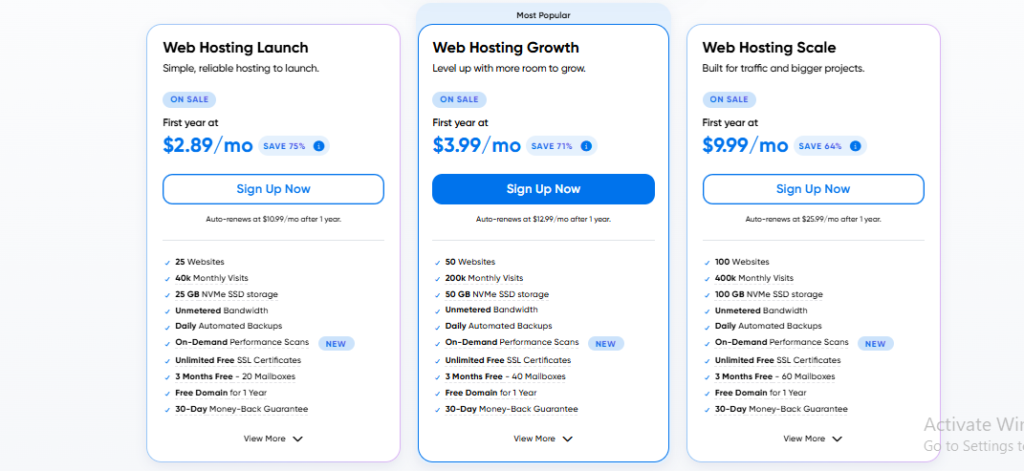
DreamHost and Hostinger both offer competitive hosting, but their pricing structures are quite different. DreamHost’s current Launch plan starts at $2.89/month for the first year and renews at $10.99/month.
It includes 25 websites, 25GB NVMe SSD storage, daily automated backups, free SSL, a free domain for one year, and a 30-day money-back guarantee. Its Growth plan starts at $3.99/month, while Scale starts at $9.99/month.
Hostinger Pricing
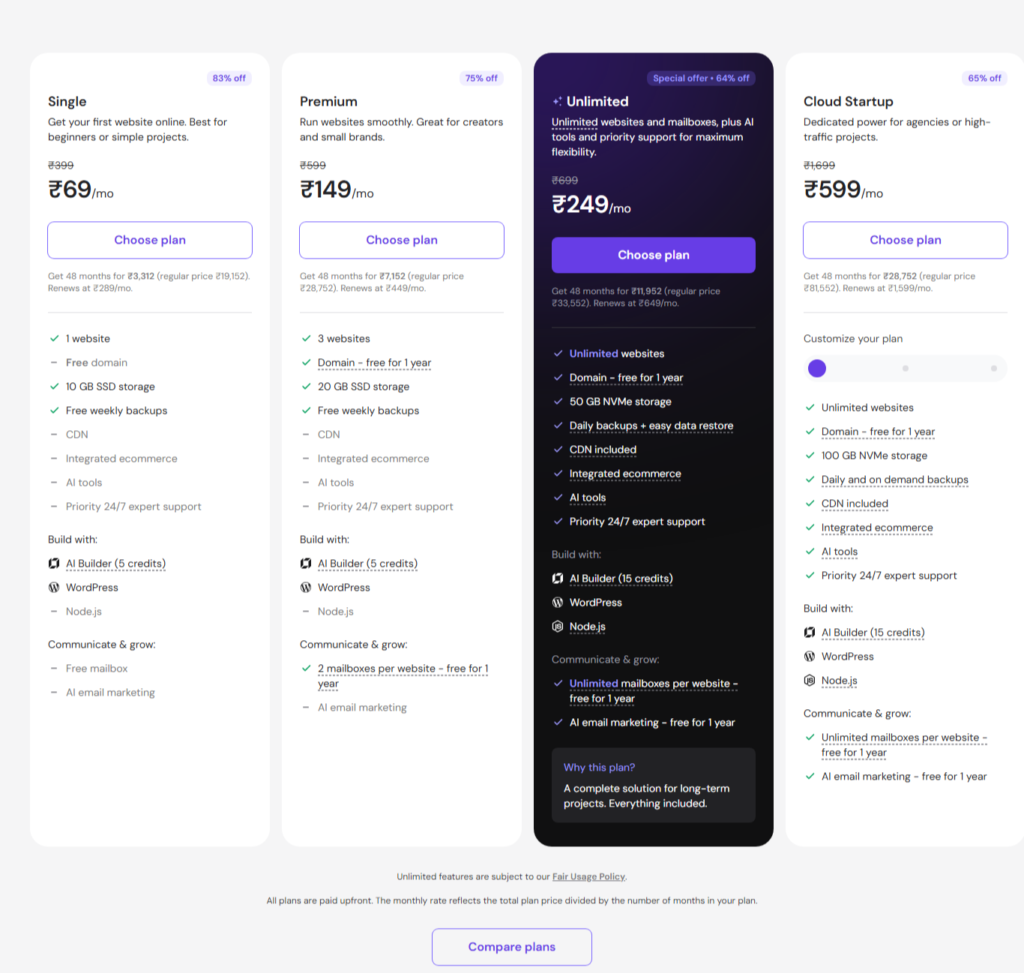
Hostinger’s India pricing starts at ₹69/month on a 48-month term. The Premium plan costs ₹149/month, while Unlimited costs ₹249/month. Renewal prices are ₹289, ₹449, and ₹649/month respectively. The plans include SSL, CDN, backups, WordPress, and other useful tools, with storage and website limits increasing as you upgrade.
Which Offers Better Value?
For budget-conscious users, Hostinger offers better overall value. Its long-term plans provide a low entry price while including features such as CDN, backups, WordPress support, and free domain eligibility. DreamHost provides more websites and daily backups even on its entry plan, but its renewal prices are considerably higher.
The important thing is to look beyond the promotional price. Both providers increase pricing after the initial term, so check the renewal cost before purchasing.
Overall, if you want the lowest upfront cost and a feature-rich hosting package, Hostinger is the stronger value. DreamHost is worth considering if its higher website limits and daily backups are more important to you.
DreamHost and Hostinger for WordPress
WordPress Setup and Management
Both providers make WordPress installation straightforward and support website migration. DreamHost also offers managed WordPress hosting through DreamPress, while Hostinger provides managed WordPress features on eligible plans.
Hostinger gets the edge for everyday management because its hPanel keeps common tasks simple, including website, domain, backup, and performance management.
If you want to learn more about managing and optimizing a WordPress website, Hostinger also provides a detailed library of WordPress tutorials and guides.
WordPress Performance and Features
Both offer storage, caching, CDN, backups, SSL, and security features to support WordPress websites. Hostinger combines these with LiteSpeed technology and CDN options, while DreamHost provides NVMe storage, daily automated backups, and managed WordPress options.
DreamHost has a dedicated knowledge base covering WordPress setup, management, and common website tasks. Its WordPress guide is a useful resource for beginners.
Which Is Better for WordPress?
Hostinger is the better choice for most WordPress users. It offers a strong combination of easy management, affordable pricing, performance features, and useful WordPress tools. DreamHost remains a solid alternative, particularly for users who want managed WordPress hosting through DreamPress.
DreamHost vs Hostinger: Features
What You Get With DreamHost
DreamHost covers the essentials for building and managing a website, including shared hosting, WordPress hosting, VPS, dedicated hosting, SSL, backups, and a website builder. Its WordPress-focused plans add managed features for users who want less technical maintenance. DreamHost also provides developer-friendly tools and access to its custom hosting panel.
What You Get With Hostinger
Hostinger packs a lot into its hosting plans. Depending on the plan, you get SSD/NVMe storage, SSL, CDN, backups, WordPress tools, caching, email, ecommerce features, and a website builder. It also stands out for its growing range of AI tools, including AI website creation, content generation, image generation, and other website-building tools.
Which Host Offers More for the Money?
For most users, Hostinger offers more overall value. DreamHost has a solid feature set, but Hostinger combines useful hosting tools with AI features, CDN, caching, and beginner-friendly management at competitive prices.
DreamHost vs Hostinger: Customer Support
Support Channels and Availability
Both providers offer 24/7 support. DreamHost provides live chat and email support, with callbacks available on eligible plans or as a paid add-on.
Hostinger provides 24/7 customer support through online assistance and live chat, with AI-powered support available for common questions and troubleshooting.
Response Time and Support Quality
DreamHost states that live chat typically begins within a few minutes, while email responses generally take one to two hours. Hostinger focuses heavily on fast online assistance through hPanel and its support tools.
For beginners, both are relatively easy to use, although Hostinger’s centralized hPanel experience can make everyday support and hosting management feel simpler.
Which Has Better Support?
Hostinger gets a slight edge for most beginners, mainly because its support experience is closely integrated with hPanel and its hosting tools. DreamHost is still a strong option, particularly if you prefer email support and callback availability.
DreamHost and Hostinger: User Reviews and Ratings
Before choosing a hosting provider, it’s worth seeing what actual customers say. For this comparison, we checked Trustpilot, G2, and HostAdvice. Keep in mind that ratings and review counts can change over time.
Trustpilot Reviews
DreamHost currently has a 4.6/5 rating from 8,179 reviews, while Hostinger has 4.6/5 from more than 71,000 reviews. Both have an “Excellent” overall Trustpilot score, but Hostinger has a dramatically larger review volume.
G2 Reviews
On G2, DreamHost has 4.1/5 from 193 reviews, while Hostinger scores 4.4/5 from 834 reviews. Hostinger therefore has both the higher rating and substantially more reviews on the platform.
HostAdvice Reviews
HostAdvice currently gives DreamHost 4.3/5 based on 292 user reviews, while its Hostinger India profile shows 5.0/5 from 2,470 user reviews. HostAdvice reviewers generally highlight ease of use, support, features, and value when discussing both providers.
Overall, Hostinger has the stronger review profile across these platforms, but ratings shouldn’t be the only deciding factor. Consider them alongside pricing, features, performance, security, and customer support.
DreamHost vs Hostinger: Pros and Cons
DreamHost Pros and Cons
Hostinger Pros and Cons
Overall, Hostinger offers the better balance of price, features, and ease of use, while DreamHost remains a solid choice for users who prefer its hosting options and WordPress-focused approach.
DreamHost vs Hostinger: Which Is Better?
Choosing between these two comes down to what you need from your hosting. DreamHost vs Hostinger is a close comparison, but Hostinger is the better overall choice for most website owners because it combines affordable pricing, simple management, strong WordPress tools, and useful performance features.
Choose Hostinger If…
Hostinger makes the most sense if you’re a beginner, blogger, small business owner, or WordPress user who wants to get a website online without dealing with unnecessary complexity. Its hPanel is easy to navigate, while its plans include features such as SSL, backups, CDN, caching, and AI-powered tools. It also offers shared, cloud, and VPS hosting, giving you room to upgrade as your website grows.
Choose Hostinger if your priorities are:
- Affordable hosting
- Easy-to-use control panel
- WordPress-friendly tools
- Strong features for the price
- A simple path to scaling your website
Choose DreamHost If…
DreamHost is worth considering if you prefer its WordPress-focused approach, custom control panel, and broader hosting options. Its current plans include NVMe storage, daily automated backups, free SSL, and a 30-day money-back guarantee.
Choose DreamHost if you:
- Prefer its WordPress ecosystem
- Want its specific hosting features
- Value daily automated backups
- Prefer its custom hosting experience
- Want flexible hosting options as your needs change
Bottom line: For most users, I’d choose Hostinger for its combination of price, simplicity, features, and overall value. DreamHost is a solid alternative, but Hostinger offers the more compelling package for the average website owner.
Final Verdict – DreamHost vs Hostinger
After comparing pricing, features, performance, WordPress support, security, and ease of use, Hostinger is the overall winner for most website owners. It offers a stronger combination of affordable pricing, simple management, useful features, and room to grow.
Best for beginners: Hostinger — its easy-to-use hPanel makes everyday website management straightforward.
Best for WordPress: Hostinger — it combines WordPress support with caching, CDN, backups, SSL, and an easy management experience.
Best for speed: Hostinger gets the edge overall, thanks to its SSD/NVMe storage, LiteSpeed servers, caching, CDN, and performance-focused options.
Best for budget-conscious users: Hostinger — its current entry-level plan starts at ₹69/month on a 48-month term, with SSL, backups, CDN, and other useful features included.
Best for growing websites: Hostinger — its higher-tier and cloud plans make upgrading easier when your website needs more resources.
DreamHost is still a solid choice, particularly if you prefer its WordPress-focused approach, NVMe storage, daily automated backups, and wider website limits. Its biggest weakness is that renewal pricing can become considerably higher. Hostinger’s main drawback is also higher renewal pricing, while some advanced features require upgrading.
Our Final Rating
Hostinger: 4.7/5
DreamHost: 4.5/5
If you want hosting that is affordable, easy to manage, feature-rich, and suitable for growing websites, Hostinger is worth the money and is the one I would choose for most users.
Frequently Asked Questions
Is DreamHost better than Hostinger?
DreamHost is a good option for WordPress users, but Hostinger is better overall for most users because of its pricing, ease of use, and features.
Is Hostinger better than DreamHost?
Yes. Hostinger offers better overall value, beginner-friendly management, strong WordPress tools, and good performance.
Which is cheaper, DreamHost or Hostinger?
Hostinger is generally cheaper, especially at the introductory level. However, compare renewal prices before purchasing.
Which is faster, DreamHost or Hostinger?
Both can provide fast performance. Hostinger gets the edge due to its LiteSpeed servers, caching, CDN, and SSD/NVMe storage.
Which is better for WordPress?
Hostinger is the better choice for most WordPress websites because it combines easy management, performance features, backups, and competitive pricing.
Is DreamHost good for beginners?
Yes. DreamHost has a beginner-friendly interface and straightforward WordPress setup, although Hostinger’s hPanel is generally easier to navigate.
Is Hostinger good for beginners?
Yes. Hostinger is particularly beginner-friendly because of its simple hPanel, easy WordPress setup, and straightforward hosting management.
Which has better customer support?
Both offer 24/7 support. Hostinger gets a slight edge for its simple online support experience, while DreamHost offers live chat and email support.
Does DreamHost offer VPS hosting?
Yes. DreamHost offers VPS hosting for websites that need more resources and control than shared hosting.
Does Hostinger offer VPS hosting?
Yes. Hostinger offers VPS hosting with additional resources and control for growing or more demanding websites.
Can I migrate from DreamHost to Hostinger?
Yes. Hostinger provides website migration options for eligible websites, making it possible to move your site from DreamHost.
Can I migrate from Hostinger to DreamHost?
Yes. You can migrate your website from Hostinger to DreamHost, either manually or with DreamHost’s available migration assistance.