If you’re choosing between two popular hosts, picking the wrong one can mean paying more, dealing with confusing tools, or outgrowing your plan sooner than expected. Hostinger vs IONOS is a close comparison, but the better choice depends on what you actually need.
In a nutshell, Hostinger is the better option for most beginners, bloggers, and small businesses because it combines affordable pricing, easy management, strong WordPress features, and solid performance. IONOS is worth considering if you need its particular hosting options or business-focused services.
Popularity also makes this comparison worth looking at. W3Techs currently tracks Hostinger on around 4% of websites versus about 2% for IONOS. Hostinger also reported 4.6 million customers across 150+ countries at the end of 2025.
I’ve used Hostinger for website projects myself, and its simple dashboard and straightforward WordPress setup are a big reason I keep recommending it for users who don’t want unnecessary technical complexity.
But price isn’t everything. I’ve compared both hosts across pricing, performance, WordPress features, security, support, and ease of use to see which one actually offers better value.
Let’s break down Hostinger and IONOS and find out which hosting provider deserves your money in 2027.
Hostinger vs IONOS: Quick Comparison
If you’re comparing Hostinger and IONOS, the biggest difference is how they balance price, simplicity, features, and scalability. Hostinger is particularly appealing to beginners and small businesses, while IONOS offers a broad range of hosting and server options for different website needs.
| Feature | Hostinger | IONOS |
| Starting price | From ₹69/mo* | From $1/mo* |
| Hosting types | Shared, Cloud, VPS | Web, WordPress, VPS, Cloud |
| Storage | 10GB+ SSD/NVMe | SSD/NVMe, plan-dependent |
| Websites | 1 to unlimited | 1 to unlimited |
| Free domain | Yes, eligible plans | Yes, eligible plans |
| SSL | Free SSL | Free SSL |
| Backups | Weekly/daily, plan-dependent | Daily backups, plan-dependent |
| CDN | Included on eligible plans | Available |
| WordPress | Managed WordPress hosting | WordPress hosting |
| VPS | Self-managed VPS | VPS with root access |
| Support | 24/7 | 24/7 |
| Money-back guarantee | 30 days | 30 days |
| Links | Hostinger.com | Ionos.com |
*Promotional pricing and features vary by region, plan, and billing term. Check the providers’ current pricing before purchasing.
Quick Verdict:
Best overall: Hostinger – better balance of price, ease of use, and features for most websites.
Best for beginners & WordPress: Hostinger – its simple dashboard and straightforward setup make getting started easier. A strong choice for bloggers and small businesses looking for managed WordPress tools.
Best for VPS & business hosting: IONOS – better suited to users who need root access, flexible server resources, or broader business hosting options.
Overall, Hostinger is the better choice for most website owners, while IONOS becomes more interesting when specific server capabilities or business requirements matter more than simplicity.
Hostinger and IONOS: Key Differences
The biggest differences come down to simplicity, resources, performance, and server control. Here’s what matters when choosing between them.
Hosting Plans and Resources
Hostinger offers shared, cloud, and VPS hosting, with resources increasing as you move to higher plans. Its current plans include SSD or NVMe storage, while VPS plans provide dedicated vCPU, RAM, storage, and bandwidth. IONOS also offers web hosting, cloud, and VPS, with its VPS plans providing NVMe storage, unlimited traffic, and full root access.
For most beginners and small websites, Hostinger offers better value. IONOS becomes more attractive when you need greater server control.
Control Panel and Ease of Use
Hostinger’s hPanel is designed to keep website, domain, email, and hosting management straightforward. IONOS uses its own control and Cloud Panel, which provides more server-management options but can feel less intuitive for first-time users.
Hostinger wins for beginners and everyday website management.
Performance and Server Technology
Hostinger combines NVMe storage, LiteSpeed servers, Object Cache, CDN, and globally distributed data centers to improve loading speed and handle traffic efficiently. IONOS VPS plans use NVMe storage, up to 1 Gbps external connectivity, and unlimited traffic.
For standard websites, both provide capable infrastructure, while your plan and website optimization will have a major impact on real-world speed.
Security and Backups
Both providers include important security features such as SSL and DDoS protection. Hostinger also offers malware scanning, firewall protection, account isolation, and backups. IONOS provides firewall management, IPS/IDS, DDoS protection, and optional cloud backups on VPS plans.
Hostinger has the simpler all-in-one approach, while IONOS offers more server-level controls.
WordPress Features
Both support WordPress installation and management. Hostinger adds automatic updates, pre-update backups, caching, CDN, and free migration tools, making it particularly convenient for WordPress users.
You can also see our Hostinger review for a deeper look at its WordPress experience.
VPS and Scalability
Hostinger’s VPS plans offer up to 8 vCPU cores, 32 GB RAM, 400 GB NVMe storage, and 32 TB bandwidth on its current lineup. IONOS VPS offers full root access, flexible server configurations, and unlimited traffic.
Overall, IONOS has the edge for users who want deeper server control, while Hostinger is easier for users who want power without unnecessary complexity.
For most website owners, Hostinger is the more balanced choice, while IONOS makes more sense for technical users and specific VPS requirements.
Hostinger vs IONOS Pricing
Pricing looks attractive at first glance with both hosts, but the renewal cost and included features matter more when you’re planning to keep a website for several years.
Hostinger Pricing
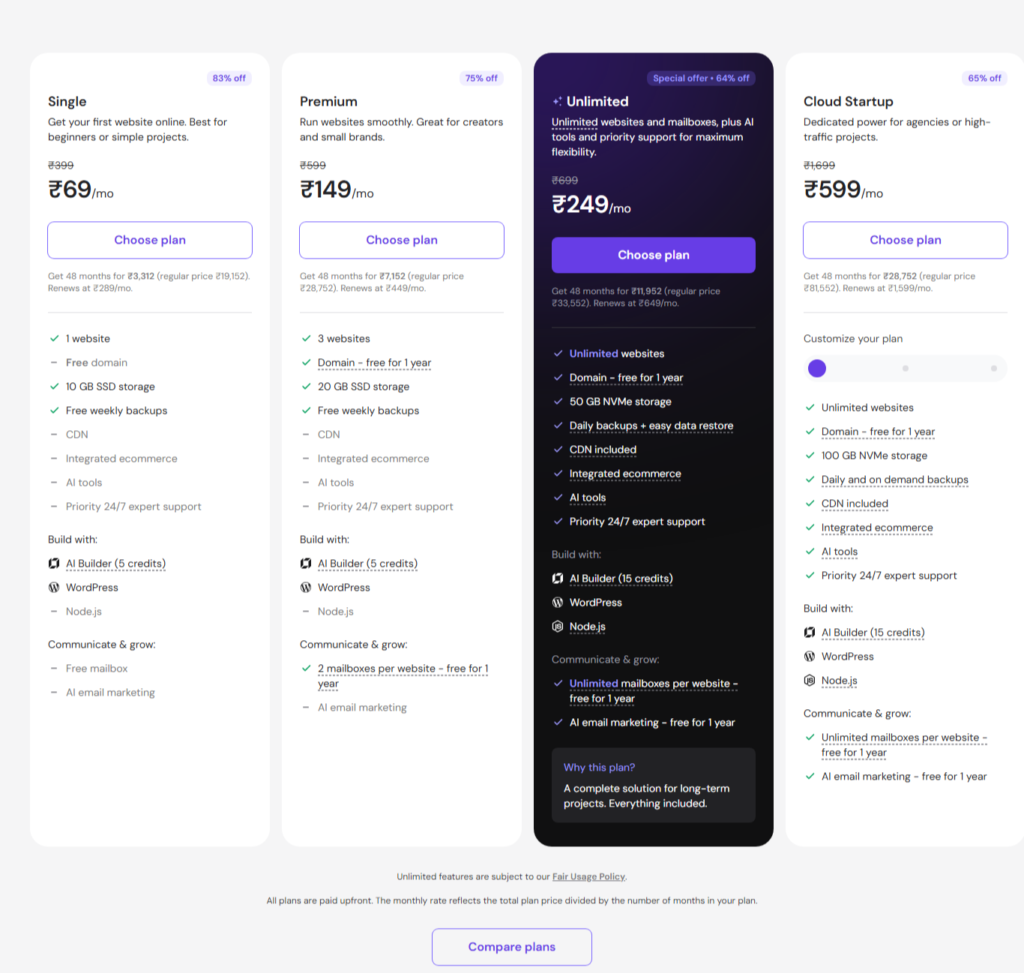
Hostinger’s current India plans start at ₹149/month on a 48-month term. Its Premium plan includes 3 websites, 20GB SSD storage, free domain for one year, SSL, weekly backups, and a CDN. The Unlimited plan costs ₹249/month and adds unlimited websites, 50GB NVMe storage, daily backups, and CDN. Renewal prices are higher, so check the current rate before purchasing.
IONOS Pricing
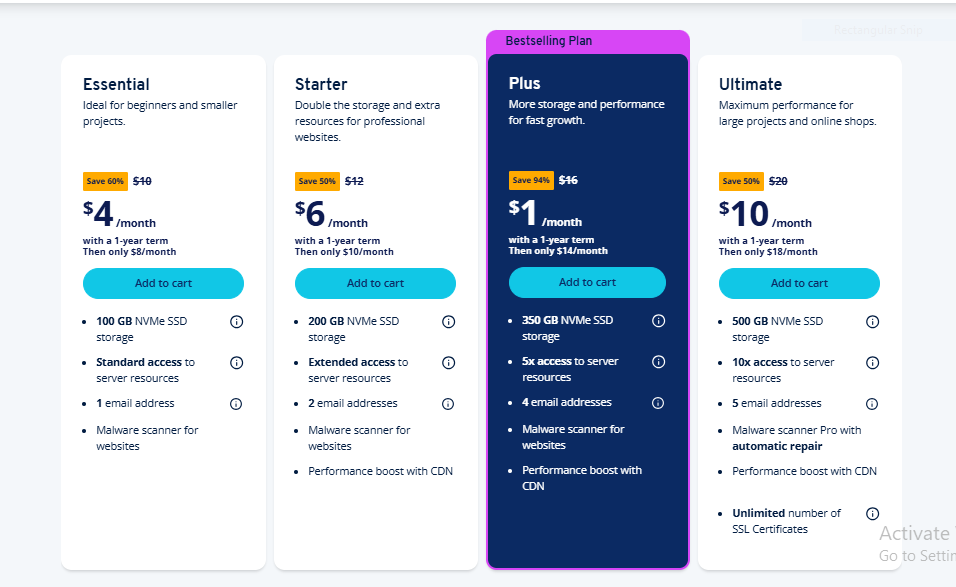
IONOS offers web hosting starting from $1/month on promotional pricing, with plans including a free domain for the first year, SSL, professional email, and different levels of storage and resources. Its VPS plans start from $4/month and include NVMe storage, root access, and unlimited traffic.
Which Offers Better Long-Term Value?
When comparing Hostinger vs IONOS, don’t judge them solely by the first-year price. Promotional rates can make either provider look extremely cheap, while renewal pricing can be significantly higher.
Hostinger offers better overall value for beginners, bloggers, and small businesses because more useful website-building and WordPress features are bundled into its plans. IONOS can be a better fit for users who prioritize flexible server options and VPS resources.
For most users, I’d choose Hostinger for the combination of price, features, and simplicity, while IONOS is worth considering when its specific server options better match your needs.
Hostinger and IONOS: Performance
When it comes to performance, both Hostinger and IONOS offer capable infrastructure, but the better choice depends on your website size, traffic, and hosting plan.
Speed and Page Load Times
Hostinger uses LiteSpeed servers, SSD/NVMe storage, caching, and CDN integration to improve website loading speeds. Its higher-tier plans also provide more resources for websites handling increased traffic.
IONOS also uses SSD/NVMe storage and offers performance-focused hosting with scalable resources. Its infrastructure is designed to support websites and applications that need consistent performance.
For a typical WordPress blog or small business website, both should provide more than enough performance when properly optimized.
If you want to test your website speed, read the tutorial here.
Server Locations and Infrastructure
Hostinger operates a global network of data centers, allowing you to select a location closer to your target audience. Choosing a nearby server can reduce latency and improve the visitor experience.
IONOS operates data centers across North America and Europe, with infrastructure designed for availability and scalability.
If most of your visitors are in a specific region, choosing the closest available data center is more important than simply picking one provider over the other.
Uptime and Reliability
Hostinger provides a 99.9% uptime guarantee, while IONOS advertises over 99.99% uptime for its web hosting infrastructure.
So, Hostinger vs IONOS performance is not a simple speed win. Hostinger is an excellent choice for most blogs, portfolios, and small businesses, while IONOS has an edge on paper for uptime and infrastructure-focused hosting.
Overall winner: Hostinger for most websites; IONOS for demanding infrastructure needs.
Hostinger vs IONOS for WordPress
If WordPress is your main focus, both hosts make setup relatively simple, but Hostinger has a slight advantage in overall ease and WordPress-focused features.
WordPress Setup and Management
Hostinger provides straightforward WordPress installation, automatic updates, migration tools, and a beginner-friendly dashboard. Its managed WordPress plans are designed to reduce the technical work involved in running a site.
If you want to learn more about managing and optimizing a WordPress website, Hostinger also provides a detailed library of WordPress tutorials and guides.
IONOS also offers WordPress hosting with pre-installed WordPress, automatic updates, and AI-powered website creation tools.
IONOS offers resources covering WordPress setup, management, and troubleshooting, making its WordPress help and guides useful for website owners.
WordPress Performance Features
Hostinger combines caching, CDN integration, optimized servers, and higher-tier resources to help WordPress websites load faster. Staging is also available on eligible plans, which is useful when testing major changes before publishing.
IONOS uses SSD-based infrastructure and provides performance-focused WordPress hosting, with its own optimization features designed to improve loading times.
Security, Backups, and Updates
Both providers include SSL and automated WordPress updates. Hostinger also provides automatic backups and security features, while IONOS includes automated updates and security-focused hosting features depending on the plan.
Security is an important part of hosting, and IONOS provides resources covering website protection and SSL encryption. See its website security guide for more details.
Which Is Better for WordPress?
When comparing Hostinger and IONOS, Hostinger is the better choice for most WordPress users. It offers a strong combination of easy management, WordPress optimization, backups, caching, CDN, and migration tools.
IONOS remains a solid alternative, particularly if its WordPress plans or business-focused services better match your requirements. But for bloggers, small businesses, and beginners who want an easier WordPress experience, Hostinger gets the edge.
Hostinger and IONOS: Features
Features can make a big difference when comparing hosting providers. Both Hostinger and IONOS cover the essentials, but they package their tools differently.
What You Get With Hostinger
Hostinger includes free SSL, domain registration on eligible plans, email hosting, CDN, backups, and WordPress tools. It also offers AI-powered tools and a website builder, which can be useful if you want to build a site without relying on several separate services.
Higher-tier plans add more storage, daily backups, caching, and additional resources, giving you room to grow without immediately moving to another provider.
What You Get With IONOS
IONOS also provides free SSL, a domain for the first year on eligible plans, professional email, website-building tools, and WordPress hosting. Its ecosystem extends into VPS and cloud services, making it a broader option if you eventually need more advanced infrastructure.
IONOS also includes AI-powered website-building features, while its WordPress plans offer SSD storage, CDN, daily backups, and other optimization tools.
Which Host Offers Better Value?
When comparing Hostinger vs IONOS, both provide enough features for most websites. The difference is how easily you can use them and what you get for your budget.
Hostinger offers better overall value for most users, particularly beginners, bloggers, and small businesses. Its combination of hosting, WordPress tools, CDN, backups, email, AI features, and website-building tools makes it a convenient all-in-one package.
IONOS is a strong alternative if you value its broader range of hosting, VPS, and cloud services.
Winner: Hostinger for overall feature value; IONOS for broader infrastructure options.
Hostinger vs IONOS: Customer Support
Good support matters most when something breaks and you need an answer quickly. Both providers offer 24/7 assistance, but the overall experience is slightly different.
Support Channels and Availability
Hostinger provides 24/7 support through online chat, with its AI assistant helping handle common questions before connecting users with human specialists when needed. It also has a large knowledge base with tutorials and guides.
IONOS offers 24/7 customer support, including phone and online support. It also provides a knowledge center and personal consultant service for eligible customers, which can be useful for business users.
Response Time and Support Quality
Hostinger’s chat-based system is convenient for everyday questions, especially when you’re setting up WordPress, managing domains, or troubleshooting common hosting issues. However, users who prefer speaking to someone directly may find the lack of phone support limiting.
IONOS has the advantage of offering phone support, which can be helpful when dealing with urgent or complicated issues. However, user feedback about support quality is mixed, so the experience can depend on the issue and support representative.
Which Has Better Support?
For most beginners, Hostinger offers the simpler support experience, particularly for routine website and WordPress questions. IONOS is more appealing if having phone support is important to you.
Winner: Hostinger for simplicity; IONOS for support-channel variety.
Hostinger and IONOS: User Reviews and Ratings
Real customer reviews can reveal things that pricing tables and feature lists don’t. For this comparison, it’s useful to look at multiple review platforms rather than relying on a single rating.
Trustpilot Reviews
On Trustpilot, Hostinger currently has a 4.6/5 TrustScore with more than 71,000 reviews, while IONOS has a 4.6/5 score with more than 44,000 reviews.
The ratings are currently similar, although Hostinger has a considerably larger review volume. You can verify the latest numbers on Hostinger’s Trustpilot profile and IONOS’s Trustpilot profile.
G2 Reviews
G2 currently rates Hostinger at 4.4/5 from more than 800 reviews. IONOS 1&1 Domains and Hosting has a lower rating, with G2’s product listing showing 3.5/5 from around 150 reviews.
Reviewers commonly highlight Hostinger’s usability and value, while IONOS feedback includes praise for pricing but also criticism around support and usability.
For independent customer feedback, you can also check Hostinger reviews on G2, and IONOS reviews on G2.
HostAdvice Reviews
HostAdvice currently shows Hostinger at 5.0/5 from 2,470 user reviews, compared with 4.7/5 from 385 reviews for IONOS.
Before choosing a provider, you can also compare customer reviews through Hostinger reviews on HostAdvice and IONOS reviews on HostAdvice.
Overall, the review platforms point toward Hostinger having the stronger user sentiment, while IONOS remains a well-established alternative. Ratings change over time, so check the linked profiles before making your final decision.
Hostinger vs IONOS: Pros and Cons
Choosing between the two becomes easier once you look beyond the feature lists. Both are capable hosts, but they suit different types of users.
Hostinger Pros and Cons
IONOS Pros and Cons
Overall, Hostinger focuses more on simplicity and value, while IONOS gives you greater flexibility when you need more advanced hosting options.
Hostinger vs IONOS: Which Is Better?
There isn’t one perfect host for everyone, but Hostinger is the better choice for most website owners. Its combination of affordable hosting, simple management, WordPress features, and useful performance tools makes it easier to get a website online without dealing with unnecessary complexity.
Choose Hostinger If…
Hostinger is the better fit if you’re a beginner, blogger, freelancer, or small business owner. It’s especially suitable if you want easy WordPress hosting, a straightforward dashboard, and good value from one hosting account. Its hPanel keeps everyday tasks simple, while features such as caching, CDN, backups, and WordPress tools cover the needs of most smaller websites.
Choose IONOS If…
IONOS makes more sense if you need specific server options, greater control, or scalable VPS/cloud infrastructure. Its VPS offering provides root access and flexible resources, making it more appealing to developers and technically experienced users.
When comparing Hostinger vs IONOS, I’d choose Hostinger for the majority of blogs, WordPress sites, portfolios, and small business websites. IONOS is a strong alternative when server flexibility matters more than beginner-friendly simplicity.
Bottom line: Choose Hostinger for value and ease of use; choose IONOS for greater server control and advanced hosting requirements.
Final Verdict – Hostinger vs IONOS
After comparing pricing, performance, WordPress features, security, support, and overall value, Hostinger is the better choice for most website owners. It offers a more beginner-friendly experience, strong WordPress tools, solid performance, and plenty of features at a competitive price.
Hostinger is best for beginners, bloggers, small businesses, and budget-conscious users who want an easy-to-manage hosting platform without unnecessary complexity. Its hPanel, caching, CDN, backups, and WordPress features make it a well-rounded option.
IONOS is still a strong choice for growing websites and VPS users who need more server flexibility, root access, or broader infrastructure options. However, its interface can feel less intuitive, especially for beginners.
The biggest weakness of Hostinger is that renewal prices are higher than the introductory rates, while its VPS hosting is better suited to users comfortable with server management. For IONOS, the main drawback is the less beginner-friendly experience and the complexity of its wider range of hosting options.
Final Rating
Hostinger: 4.7/5 ⭐
IONOS: 4.4/5 ⭐
Overall, Hostinger wins this comparison and is worth the money for most users because it delivers the best balance of price, performance, features, and ease of use.
If you want straightforward hosting that gives you everything needed to build and grow a website, Hostinger is the one I’d choose.
Frequently Asked Questions
Is Hostinger better than IONOS?
Yes. Hostinger is better for most users because it offers easier management, strong WordPress features, good performance, and better overall value.
Is IONOS better than Hostinger?
IONOS can be better for users who need flexible VPS hosting, root access, or more advanced server options. For beginners, Hostinger is generally the easier choice.
Which is cheaper, Hostinger or IONOS?
Both offer low introductory prices, but Hostinger provides strong value with more features on its plans. Always check renewal prices before purchasing.
Which is better for WordPress, Hostinger or IONOS?
Hostinger is the better choice for most WordPress users. It offers easy WordPress setup, automatic updates, backups, caching, CDN, and migration tools.
Is IONOS good for beginners?
Yes, IONOS is suitable for beginners, but its interface can feel less intuitive than Hostinger. Hostinger is the better option if simplicity is your priority.
Is IONOS good for VPS hosting?
Yes. IONOS is a strong VPS option, especially for users who want root access, flexible configurations, and more control over their server.
Which has better performance, Hostinger or IONOS?
Both offer strong performance with SSD/NVMe storage and reliable infrastructure. Hostinger is the better all-round choice for most websites, while IONOS is suitable for more demanding hosting requirements.
Can I migrate my website from IONOS to Hostinger?
Yes. You can migrate a website from IONOS to Hostinger using Hostinger’s migration tools. The exact process depends on your website and hosting setup.
Can I migrate my website from Hostinger to IONOS?
Yes. Websites can be migrated from Hostinger to IONOS. You may need to move your website files, database, domain settings, and email separately depending on your setup.